Let’s Prevent Burglary — This Is Korea, Not America.
Now, let’s talk about burglary.
Based on 2023 data, burglary accounts for only 5% of all thefts.
So why should we look into it?
First, although this may sound a little strange,
if you care about your safety,
it’s actually fortunate if you are only the victim of a theft
when you could have ended up facing a robbery.
That’s why I keep emphasizing that we need to consider cases in which a theft turns into a robbery.
But finding the actual number of cases in that process is extremely difficult.
So this time, let’s talk about probability using several different tables.
First, let’s briefly think about how a theft can turn into a robbery.
Let’s imagine that I am a thief.
I wouldn’t just walk into a house at random.
I would probably choose a target and try to gather information, such as who lives there and when the house is usually empty.
Then I would probably carry out the crime.
At the very least, you could call that a plan.
And I steal as much as I can.
Because my research was perfect, I continue stealing comfortably and without hesitation, even singing along the way.
But then, unexpectedly,
the homeowner happened to stay home and was sleeping that day.
Our eyes meet.
If the homeowner is a strong adult man, I’d probably run for my life.
But what if it is a child, woman, or elderly person whom I could overpower?
That’s how a thief becomes a robber.
The following is data from the Korea Institute of Criminology and Justice.
The table shows the percentage of each type of robbery committed with “no weapon or tool.”
| Type of Robbery | No Tool |
|---|---|
| Robbery / Quasi-Robbery | 68.0% |
| Special Robbery | 14.4% |
| Robbery Resulting in Injury / Robbery-Murder | 42.3% |
| Hostage Robbery | 82.4% |
| Robbery-Rape | 16.2% |
| Total | 37.5% |
A whopping 68% involve no tool or weapon.
What does it mean that a robbery was committed without a tool?
Well, I don’t think I’d go with my bare fists.
At least, if I were a robber.
In other words, I think that figure of 68% is important when considering cases where someone started out as a thief and then encountered the homeowner and turned into a robber.
Am I taking this too far?
| Robbery / Quasi-Robbery | Percentage |
|---|---|
| Accidental / Unplanned | 51.2% |
| Other motives | Remaining percentage |
Accidental / Unplanned: 51.2%.
Can robbery really be unplanned?
I have spent quite a bit of time defining the terminology, but let’s go over it again.
I said that robbery is a crime in which property is taken from another person through threats or physical force.
So what would an unplanned robbery look like?
You’re just walking down the street and suddenly think,
“I’m hungry, so I guess I’ll rob someone.”
“If I meet someone, I’ll punch them once or twice with my bare fists and take their money. Hehe.”
Would that count?
Probably not.
What “unplanned” means here
is that the entry itself was unplanned.
And there is probably an additional condition: the house appeared to be empty.
You might say, “But those conditions fit street robbery, don’t they???”
Yes, they do.
Especially in the case of street robbery, if it’s something as simple as taking students’ pocket money, that could certainly happen.
| Robbery Method | Percentage |
|---|---|
| Residential Robbery | 38.3% |
| Street Robbery | 7.4% |
| Robbery Using a Vehicle | 2.9% |
| Robbery Inside a Vehicle | 2.3% |
| Drugging Robbery | 1.4% |
| Robbery-Rape | 0.6% |
| Hostage Robbery | 0.4% |
| Maritime Robbery | 0.0% |
| Other | 46.8% |
But street robbery accounts for only 7.4% of the total.
The residential robbery I have been emphasizing is close to 38.3%.
It seems that the word “unplanned” could also apply to residential robbery.
You entered the house unexpectedly because you thought it was empty.
So naturally, you had no weapon or tool.
Up to this point, it is burglary.
If you don’t encounter anyone and simply steal some belongings and leave,
it ends as theft.
But if you encounter the homeowner or someone else,
it turns into robbery.
Now let’s look at the times when theft and robbery occur.
| Time | Theft | Robbery |
|---|---|---|
| 04:00–06:59 | 7.2% | 12.2% |
| 07:00–08:59 | 6.8% | 4.6% |
| 09:00–11:59 | 13.9% | 10.5% |
| 12:00–17:59 | 35.6% | 22.6% |
| 18:00–19:59 | 10.8% | 9.9% |
| 20:00–03:59 | 25.6% | 40.1% |
| Total | 100% | 100% |
Both theft and robbery occur frequently from noon to 6 p.m.,
and from 8 p.m. to 4 a.m.
Notice that theft is more common between noon and 6 p.m., when people are likely to be away from home because of work, school, and other activities.
Here is the data on the points of entry used by burglars.
| Point of Entry | Burglary |
|---|---|
| Entrance Door | 56.5% |
| Other | 21.3% |
| Window | 18.2% |
| Wall / Fence | 1.6% |
| Emergency Exit | 1.2% |
| Unknown | 1.1% |
A whopping 56% simply come through the entrance, as if saying, “Is anyone there?”
Between noon and 6 p.m.,
they simply enter through an open door, as if saying, “Is anyone there?”
And if someone is inside,
they can just think, “Oh, I guess this isn’t the place,” and leave.
The second-largest time period, from 8 p.m. to 4 a.m.,
they would probably look for houses with the lights off and do the same thing.
Now we know when and how they tend to move.
So how should we prepare?
First, if the thief doesn’t know that you are inside,
lock the door and call the police immediately.
That’s obvious, and everyone knows it.
You can report it by phone,
and you can also send a text message to 112. Quickly send your address and the situation.
If you already have the 112 emergency reporting app installed, you can make a report within three seconds.
And after locking the door, it is better to let the thief know that the police have been called and give them time to run away.
The police should catch the thief.
You don’t know whether the intruder is carrying a knife or is a serial robber rather than an opportunistic criminal.
The best option is to avoid encountering them.
But I think we also need to prepare for the worst-case scenario: when neither side knows the other is there and you suddenly encounter each other,
or when you don’t have your smartphone with you.
And that is:
A whistle

Yes, this thing.
It’s not expensive either.
It’s a good idea to buy about five and hang them in different areas of the house.
Then just blow the hell out of it.
Just like in the movies…
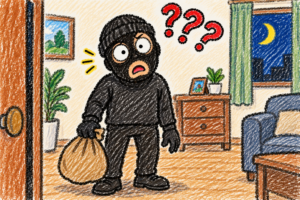
Hey, what are you doing?
What if it turns out like this??
Hmm… good point.
But then what else can you do?
Blow the whistle and yell, “Thief!” so someone comes running in panic,
or maybe the thief will hear it and think, “What the hell is this?” and run away.
You’ve got to do something.
Don’t you think?
There are also things like pepper spray, but the very fact that you have to use spray
means the situation has already reached the worst possible point.
The whistle is meant to prevent the situation from getting that far.
Still, when all is said and done,
keeping your doors properly locked is probably the best option, right?